George Yiasemis

Postdoctoral Researcher · NKI & UvA · Amsterdam

George Yiasemis, PhD, MSc

AI for Oncology · Deep Learning · Computer Vision

Reconstruction Foundation models Medical imaging Digital pathology Open source

AI for Oncology Lab · Netherlands Cancer Institute · University of Amsterdam

I am a postdoctoral researcher at the Netherlands Cancer Institute, supervised by Jonas Teuwen, working on deep learning and computer vision for AI in oncology. My main focus is medical image reconstruction; I also work on foundation models and collaborate on AI projects involving radiology, surgery, pathology, biology, and proteomics.

I lead the open-source DIRECT reconstruction toolkit and contribute to foundation model research through AIFOFOMO in the Foundation Models for Oncology Lab. I completed my PhD at the NKI and UvA on deep learning for MRI reconstruction, adaptive sampling, and motion estimation, supervised by Jonas Teuwen, Jan Jakob Sonke, and Clara I. Sánchez.
georgeyiasemis@hotmail.com Amsterdam, Netherlands
Profile

About Me

AI researcher in deep learning and computer vision for oncology — mainly reconstruction and foundation models, with collaborative work on AI for medical imaging and molecular data.

Research Focus

  • Medical image reconstruction & inverse problems
  • Foundation models for oncology
  • AI for radiology, surgery, pathology, biology, and proteomics (collaborative)
  • Adaptive MRI sampling, dynamic imaging, and motion estimation
  • Open AI software (DIRECT, FastSlide, AIFOFOMO)

Current Role

May 2025 — Present · NKI, Amsterdam

Postdoctoral researcher in the AI for Oncology Lab, supervised by Jonas Teuwen, working on reconstruction, foundation models (AIFOFOMO), and collaborative AI projects across imaging and molecular domains at NKI.

PhD Thesis

University of Amsterdam & NKI · 2021–2025

What We Do Sample, We Must Learn to Reconstruct: From Missing k-Space Data to Meaningful Images — Deep Learning in MRI Reconstruction and Beyond

Supervised by Jonas Teuwen, Jan Jakob Sonke, and Clara I. Sánchez. My thesis combined deep learning with inverse problems, image reconstruction, adaptive sampling, and motion estimation for accelerated MRI — with publications at CVPR, MICCAI, Medical Image Analysis, and Magnetic Resonance Imaging.
Read thesis on UvA DARE →

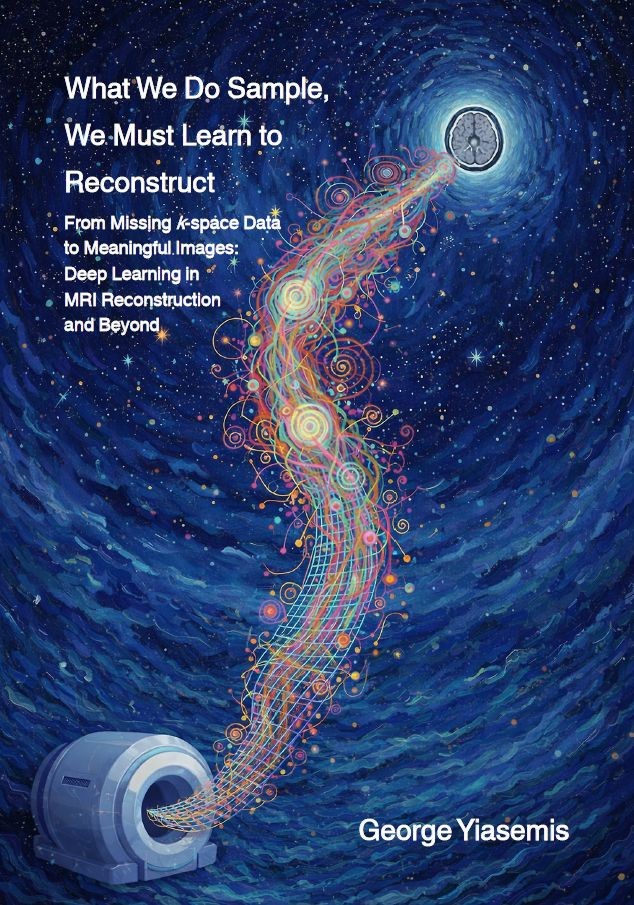
Cover art for PhD thesis: What We Do Sample, We Must Learn to Reconstruct
Updates

News & Highlights

Recent updates from conferences, milestones, and ongoing research.

ISMRM 2026 digital poster: Joint Optimization of Acquisition, Reconstruction, and Registration for Dynamic Cardiac MRI
Conference

Digital poster at ISMRM 2026, Cape Town

Our group is at ISMRM 2026 in Cape Town, where I present the digital poster Joint Optimization of Acquisition, Reconstruction, and Registration for Maximizing Motion Estimation in Dynamic Cardiac MRI, together with Dr Jonas Teuwen and Dr Jan-Jakob Sonke.

The study introduces an end-to-end framework that jointly optimizes adaptive k-space sampling, image reconstruction, and deformable registration to improve motion estimation in highly undersampled dynamic cardiac MRI — shifting the focus from image fidelity alone toward motion estimation accuracy.

Registration, Atlases, and Motion session · Abstract via ISMRM portal (membership required).

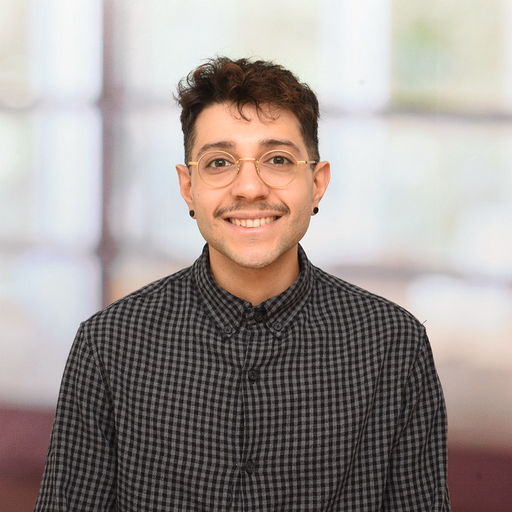
George Yiasemis at his PhD defense, April 2026
Milestone

PhD completed at UvA & NKI

I obtained my PhD from the Faculty of Medicine at the University of Amsterdam on 1 April 2026, becoming the first doctoral graduate from the AI for Oncology Lab. My thesis, What We Do Sample, We Must Learn to Reconstruct: From Missing k-Space Data to Meaningful Images — Deep Learning in MRI Reconstruction and Beyond, explored deep learning for accelerated MRI reconstruction, adaptive sampling, self-supervised learning, cross-domain generalization, and clinical validation.

Supervised by Prof. Dr. Ir. J.J. Sonke, Prof. Dr. Ir. C.I. Sánchez Gutiérrez, and Dr. Ir. J.J.B. Teuwen. I continue as a postdoctoral researcher at NKI, working on foundation models and AI for oncology.

FastSlide — high-performance whole slide image reader for digital pathology
Open Source

FastSlide open source released

Together with colleagues at NKI, I released FastSlide — a C++20 whole-slide image reader with native Python bindings for digital pathology and computational imaging. We built it because no existing Python library handled both multiplex and histopathology formats efficiently for deep learning workflows where fast random access matters more than pre-tiling.

FastSlide reads Vectra multiplex QPTIFF, SVS, MRXS, OME-TIFF, OME-Zarr, Philips iSyntax, Zeiss CZI, Ventana, Olympus VSI, and more — with native support for multi-channel fluorescence, Z-stacks, and T-series. Version 0.7.0 added Ventana and Olympus VSI support plus full focal-plane and time-point navigation. Thread-safe and PyTorch DataLoader-ready, released under Apache 2.0.

Open Source

DIRECT Toolkit

Lead developer · NKI-AI

Open Source · Lead Developer

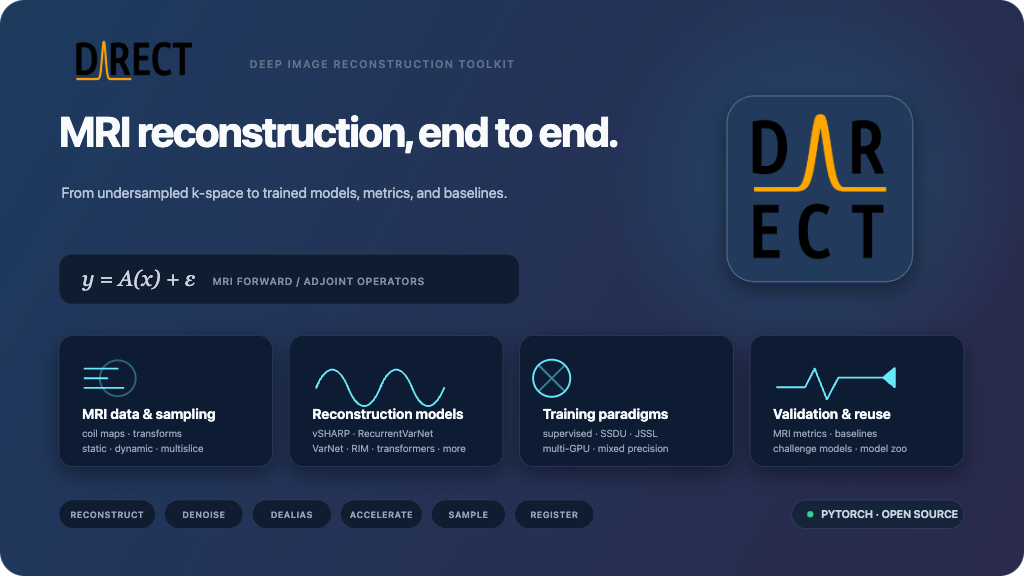
DIRECT

Deep Image REConstruction Toolkit

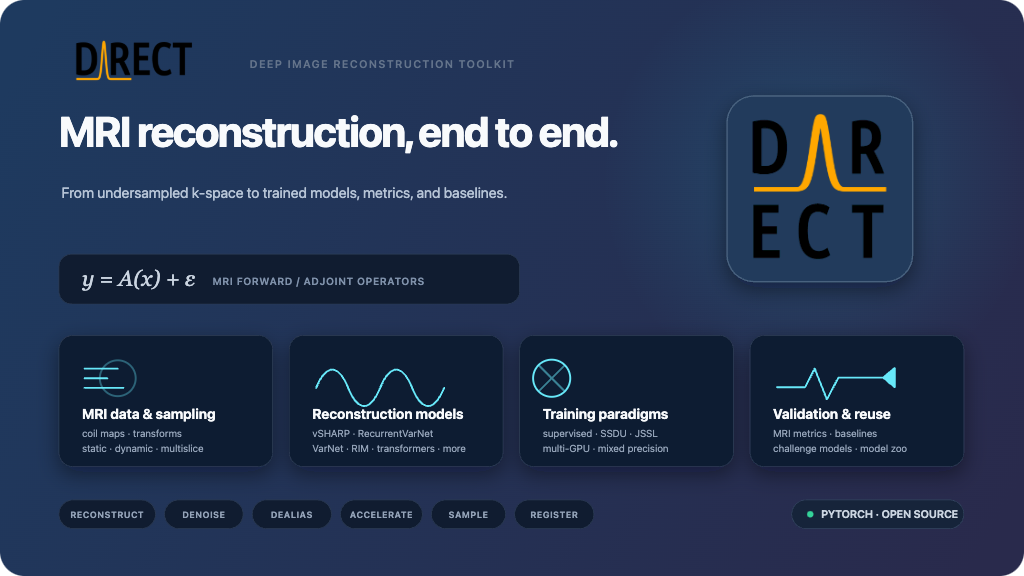
Open-source PyTorch pipeline for deep learning-based medical image reconstruction — MRI reconstruction, denoising, and dealiasing. Ships RecurrentVarNet, vSHARP, RIM, LPD, and VarNet with pretrained models in the Model Zoo and configs for Calgary-Campinas, FastMRI, and CMRxRecon.

303 GitHub stars
JOSS 2022 paper
Apache-2.0 Open license

Winner · Multi-Coil MRI Challenge 2022 · Runner-up · CMRxRecon 2023 · 2nd & 3rd · CMRxRecon 2024

DIRECT reconstruction example: zero-filled input, compressed sensing, and RIM reconstruction
Research

Selected Papers

Peer-reviewed and preprint work on reconstruction, computer vision, and deep learning for medical imaging.

Cover art for PhD thesis: What We Do Sample, We Must Learn to Reconstruct
PhD Thesis

What We Do Sample, We Must Learn to Reconstruct

PhD thesis at the University of Amsterdam and Netherlands Cancer Institute on deep learning for accelerated MRI reconstruction — from missing k-space data and adaptive sampling to self-supervised learning, cross-domain generalization, and clinical validation. First doctoral graduate from the AI for Oncology Lab.

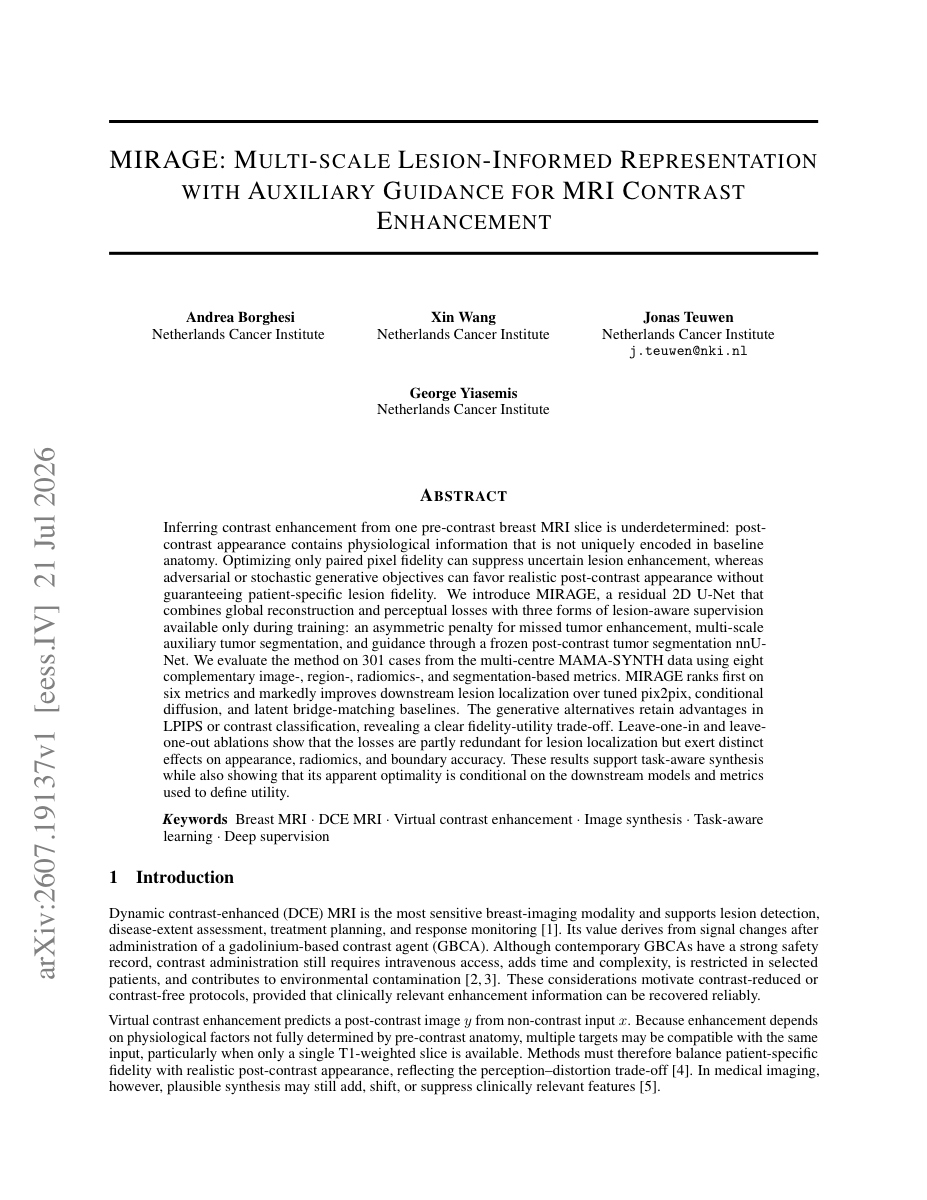
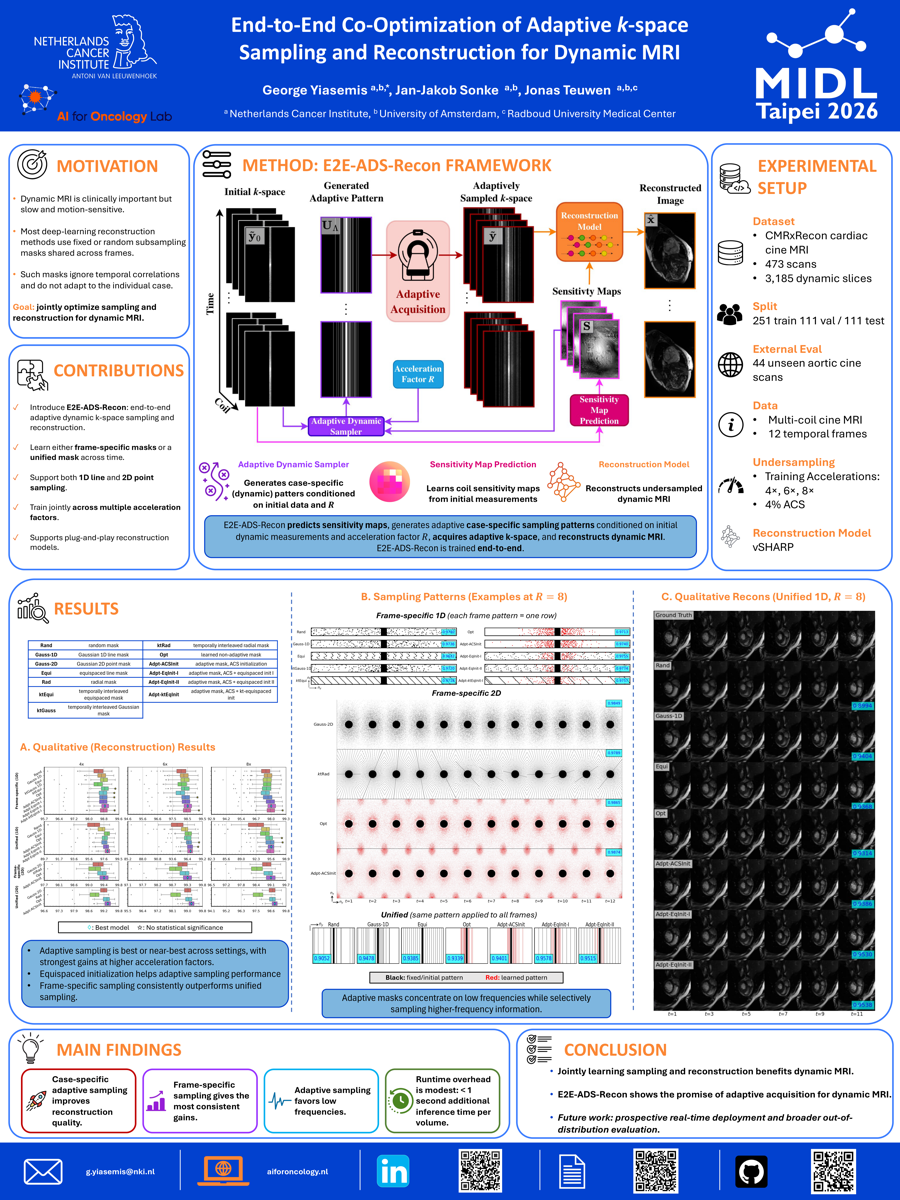
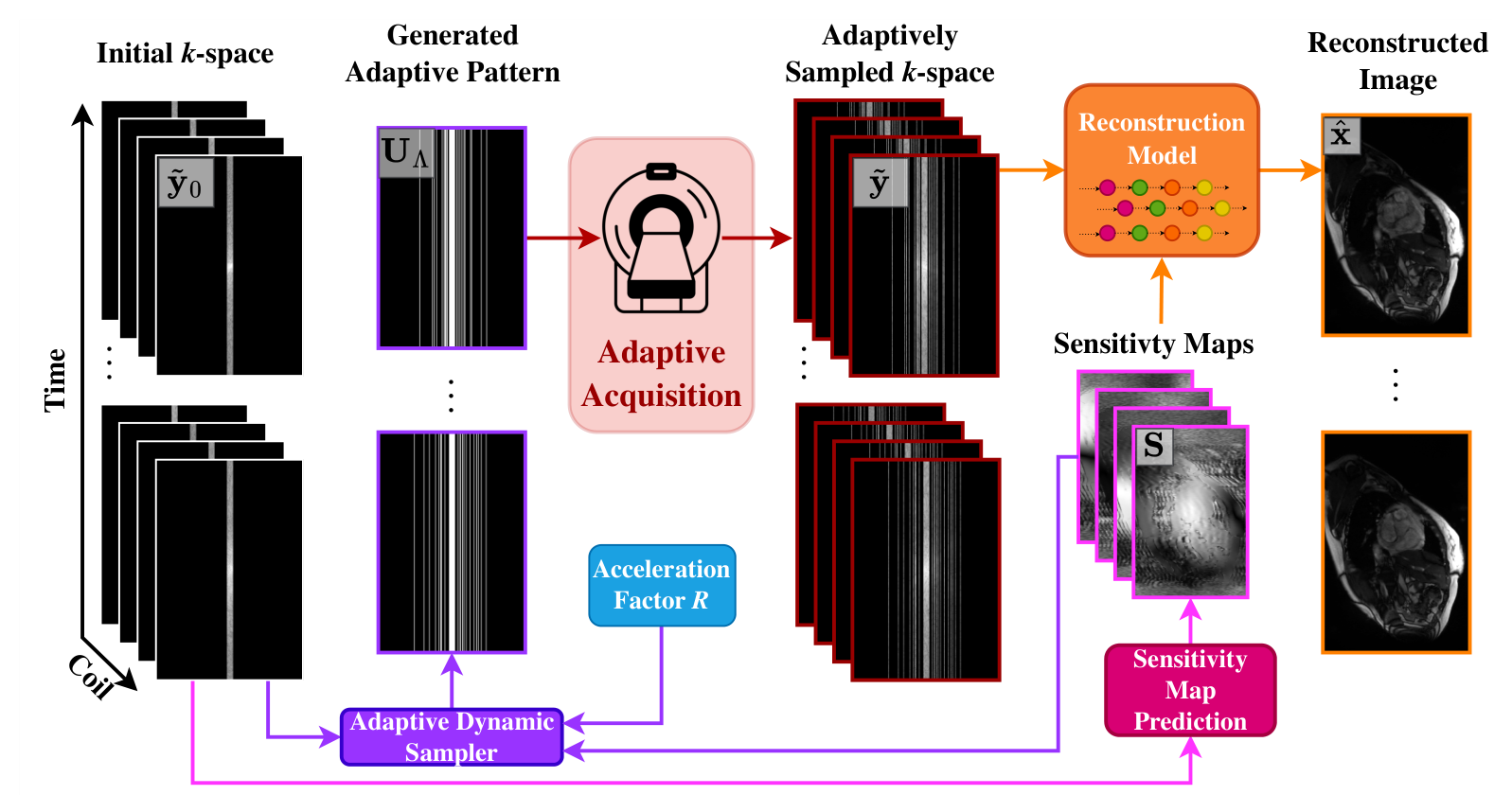
E2E-ADS-Recon pipeline for frame-specific adaptive k-space sampling and reconstruction
MIDL · Dynamic MRI

End-to-End Co-Optimization of Adaptive k-Space Sampling and Reconstruction for Dynamic MRI

E2E-ADS-Recon jointly learns frame-specific adaptive k-space sampling and dynamic MRI reconstruction end-to-end — replacing fixed subsampling patterns with learned, temporally aware sampling that improves reconstruction quality across acceleration factors.

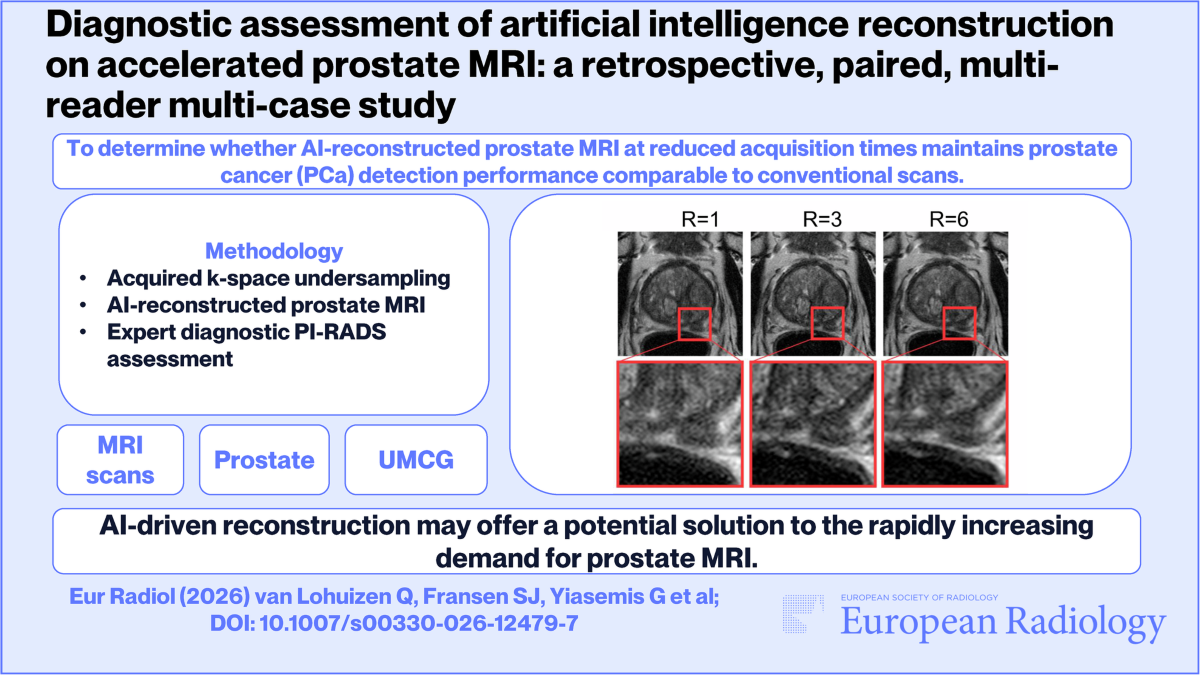
AI-reconstructed accelerated prostate MRI compared with conventional scans at R=1, R=3, and R=6
European Radiology · Prostate MRI

Diagnostic Assessment of AI Reconstruction on Accelerated Prostate MRI

Retrospective, paired, multi-reader multi-case study at UMCG showing that AI-reconstructed prostate MRI at reduced acquisition times maintains PI-RADS-based prostate cancer detection comparable to conventional scans — a step toward faster prostate MRI without compromising diagnostic performance.

vSHARP model architecture: unrolled ADMM with denoiser and data-consistency blocks
Journal · MRI

vSHARP: Variable Splitting Half-quadratic ADMM for Inverse Problems

ADMM-based deep reconstruction algorithm for inverse problems, applied to cardiac, prostate, and multi-coil brain MRI. Published in Magnetic Resonance Imaging; implemented in DIRECT and used in CMRxRecon-winning pipelines.

TAP-CT qualitative segmentation results on CT volumes
MIDL · Foundation Models

TAP-CT: 3D Task-Agnostic Pretraining of Computed Tomography Foundation Models

Task-agnostic pretraining of volumetric CT foundation models on 105k scans from NKI-AVL. State-of-the-art segmentation with frozen features and a linear head — first release from the Foundation Models for Oncology Lab.

End-to-end framework for adaptive k-space sampling, reconstruction, and registration in dynamic MRI
Dynamic MRI · Registration

End-to-End Adaptive Sampling, Reconstruction, and Registration for Dynamic MRI

Extends adaptive sampling and reconstruction with deformable registration in a single end-to-end framework, improving motion estimation in highly undersampled dynamic cardiac MRI — shifting optimization from image fidelity alone toward task-aware motion estimation.

Recurrent Variational Network architecture and accelerated MRI reconstructions
CVPR

Recurrent Variational Network: A Deep Learning Inverse Problem Solver Applied to Accelerated MRI Reconstruction

RecurrentVarNet unrolls variational inference into a compact recurrent architecture for fast, high-quality MRI reconstruction from undersampled k-space. A core method in DIRECT and the basis for multiple challenge-winning pipelines.

Career

Experience

2025 — Present

Postdoctoral Researcher in AI

Netherlands Cancer Institute · AI for Oncology Lab · Amsterdam

Supervised by Jonas Teuwen. Reconstruction and foundation models (AIFOFOMO), plus collaborative AI work with radiology, pathology, surgery, biology, and proteomics colleagues.

2021 — 2025

PhD Researcher in AI & Medical Imaging

Netherlands Cancer Institute & University of Amsterdam

Supervised by Jonas Teuwen, Jan Jakob Sonke, and Clara I. Sánchez. Deep learning for accelerated MRI acquisition, reconstruction, adaptive sampling, and real-time tumor tracking. Lead developer of DIRECT.
2020

Quantitative Research Intern

Tickmill Europe Ltd · Limassol, Cyprus

Deep learning and statistical models for financial time-series forecasting.

Background

Education

2021 — 2025

PhD in Artificial Intelligence & Medical Imaging

University of Amsterdam & Netherlands Cancer Institute

Supervisors: Jonas Teuwen, Jan Jakob Sonke, Clara I. Sánchez. Thesis: What We Do Sample, We Must Learn to ReconstructUvA DARE

2019 — 2020

MSc in Artificial Intelligence (Distinction, 82.6/100)

Imperial College London

Thesis: Mirror Descent and Interacting Mirror Descent: Almost Dimension-Free Convex Optimization for Non-Euclidean Spaces

2015 — 2019

BSc in Mathematics (Distinction, 9.46/10)

University of Cyprus · Top graduating student, Faculty of Pure and Applied Sciences

Thesis: Computational Approach of the Orr-Sommerfeld Equation with the Finite Elements Method (10/10)

2018

Erasmus+ Exchange Semester

University of Patras, Greece

Recognition

Honors & Awards

2024
2nd & 3rd Place — CMRxRecon Challenge (MICCAI)

Marrakesh, Morocco

2023
Runner-up — CMRxRecon Challenge (MICCAI)

Vancouver, Canada

2022
Winner — Multi-Coil MRI Reconstruction Challenge

Calgary, Canada

2020
Corporate Partnership Programme MSc Group Project Prize

Best AI Group Project, Imperial College London

2019
Cyprus Mathematical Society Award

Best academic performance, Department of Mathematics and Statistics

2019
Top Graduating Student

Faculty of Pure and Applied Sciences, University of Cyprus

Life

Beyond Research

Outside of work, I enjoy running, swimming, gym, skiing, pilates, cooking, reading fiction, and travelling. I thrive in collaborative settings and value multidisciplinary teamwork across research labs and hospitals.

Running Swimming Gym Skiing Cooking Travelling English Greek Dutch (beginner) Spanish (beginner)